Wednesday, August 19, 2015

Lebaran yang Sehat

Tema : Lebaran Lebih Baik

Lebaran yang Sehat


     Seperti biasa bulan puasa merupakan bulan yang di tunggu-tunggu dikarenakan pada waktu lebaran orang-orang yang di cintai berkumpul semua untuk saling silaturahmi dengan bertepatan waktu nya setiap orang untuk mudik menemui sanak family dan saudara dan kerabatnya terutama di kampung halaman. Beberapa tahun belakang ini kebetulan saya mulai mengidap penyakit maag akut dan alergi pernapasan dengan diagnosa yang salah dan malah diberi obat TBC selama hampir 1 tahun, sehingga makin parahlah penyakit saya hingga menjadi belum sembuh-sembuh dan seringa mendapat perawatan inap di Rumah Sakit, hingga akhirnya berobat ke salah satu dokter dan akhirnya ditemukan penyakit apa saya dan menghentikan pengobatan TBC yang lama itu. Akhirnya penyakit maag dan alergi ku sering kambuh karena telatnya penangan yang salah. Karena penyakitku ini yang sering menggangu sebelum bulan puasa dan mulai ketika memasuki bulan puasa. 
     Oleh karena itu sering sekali saya tidak mengikuti puasa dikarenakan penttkitku ini yang bingung untuk di sembuhkan. sehingga tidak sempurna lah ibadahku beberapa tahun ini. Selain ibadah tidak sempurna juga tidak bisa ikutan mudik atau silaturahmi ke beberapa keluarga dan sanak saudara lainnya. Sedih rasanya tidak bisa ikut silaturahmi dan mudik kesanak saudara terutama yang jauh, bahkan untuk makan-makanan dan kue-kue lebaran yang selalu dinanti tidak bisa dinikmati dengan bebas selama itu. Bahkan pas setelah lebaran sebelumnya salah satu saudaraku yang tinggal dibandung di diagnosa penyakit kangker dan getah bening, beserta ibu yang sakit-sakitan pula ikut menjaga keponakanku yang sedang sakit di jakarta, Ayahku pun yang terkena penyakit Kangker Nasoparing yang sakit nya berbarengan dengan diri saya meninggalkan seluruh keluarga duluan. Kemudian saudaraku yang di bandung seorang perempuan yang memiliki dua orang anak yang berpisah dengan suaminya. Saudaraku yang hanya tinggal sendiri dan kedua anak laki-lakinya yang ditinggal untuk bekerja. 
     Saudara perempuanku itu mengurus rumah tangga sendirian dan bekerja untuk menafkahi anak-anaknya sendirian dan kemudian didiagnosa penyakit kangker dan getah bening dan bukan hanya itu dia di guna-guna oleh dua orang sekaligus. Saudara perempuan saya kemudian berobat ke orang ahli atau kiayi yang sesuai syariah agama dan dikatakan ada keluar beling-beling kaca dan paku yang tertanam di tubuh kakak perempuan saya. 
     Rasanya lengkaplah penyakit menimpa keluargaku ini. Saya yang masih sakit-sakitan waktu itu tidak bisa bersilaturahmi dan menengok saudara perempuan saya itu. Sungguh kasihan melihat perjuangan Ibu saya yang pergi ke bandung cianjur dan Jakarta pulang pergi hanya untuk mengurus anak-anak dan cucu-cucunya. 
     Di Lebaran terakhir kemarin kami berpikir bahwa kami tidak akan bisa berkumpul dan hanya lebaran di daerah masing -masing tanpa bisa silaturahmi. dan saya sempat terpikir bahwa saya tidak akan bisa berpuasa kembali tahun ini. Tapi saya selalu berusaha untuk selalu berhusnudona dan berbaik sangka. Akhirnya puasa yang biasanya dulu dinanti mulai datang dan tanpa disangka ketika saya mencoba berpuasa sehari-dua hari ternyata maag akut dan alergi pernapasan biasa saja hanya sedikit terasa lama-lama seminggu ternyata saluran pencernaan saya makin bertambah baik dan nyaman. Hingga akhir nya saya memutuskan untuk pergi bersilaturahm ke saudara perempuanku juga. Tetapi waktu itu pekerjaan saya yang harusnya libur malah menjadi bertambah. Dengan perasaan bersabar akhirnya seminggu sebelum lebaran kesibukan saya sudah berkurang. dan akhirnya saya memutuskan untuk liburan dan menjenguk saudara perempuan saya di bandung.
     Dan ketika tiba di rumah Saudara saya itu ternyata Saudara saya itu sudah mulai sembuh dari penyakit-penyakit kangker dan guna-guna sehingga bisa beraktivitas kembali menuju normal. betapa bahagianya saya seminggu tinggal menemani saudara saya dan akhir nya pas hari Lebaran tiba kami semua bisa pulang mudik kembali ke Cianjur sehingga yang dari jakartapun kumpul datang mudik dan berfoto bersama.


   Perasaan bahagia dan Suka terpancar dari wajah kami semua yang awalnya kami pikir tahun ini kami tidak akan bisa kumpul kembali bersama seperti Lebaran-lebaran yang dulu. Tetapi Allah berkehendak lain buah dari kesabaran, berdo'a dan ikhtiar untuk selalu berusaha untuk berobat dengan benar akhirnya mendapatkan akhir yang baik dan bahagia. Sehingga kami bisa berkunjung bersama ke keluarga lain dan jalan-jalan. Sehingga Tahun ini adalah Lebaran Lebih Baik dari beberapa tahun sebelumnya yaitu Lebaran yang Sehat dan menyenangkan. Terimakasih ya Allah atas segala nikmatmu yang kau kembalikan kepada kami di tahun ini.         :-) 


Wednesday, January 7, 2015

seven wonders of India

1. Bahubali


Bahubali (Sanskrit: बाहुबली) also called Gommateshwara (Kannada: ಗೊಮ್ಮಟೇಶ್ವರ Tulu: ಗೊಮ್ಮತಾ) was a son of Arihant Adishwar. According to Jainism, he was the second of the hundred sons of the first Tirthankara, Rishabha and king of Podanpur. The Adipurana, a 10th-century Kannada text by poet Adikavi Pampa (fl. 941 CE), written in Champu style, a mix of prose and verse and spread over in sixteen cantos, deals with the ten lives of the first tirthankara, Rishabha and his two sons, Bharata and Bahubali.[1][2] According to the Digambaras he was the first human in this half time cycle to attain liberation.[3]
A monolithic statue of Bahubali referred to as "Gommateshvara" built by the Ganga dynasty minister and commander Chamundaraya is a 57 feet (17 m) monolith and is situated above a hill in Shravanabelagola, in the Hassan district of Karnataka state, India. It was built in the 10th century AD.[citation needed] Hundreds of thousands of pilgrims, devotees and tourists from all over the world flock to the statue once in 12 years for an event known as Mahamastakabhisheka. On August 5, 2007, the statue was voted by Indians as the first of Seven Wonders of India.[4] 49% votes went in favor of this marvel.


2. Harmandir Sahib

 Golden-Temple-Jan-07.jpg  


The Harmandir Sahib (Punjabi: ਹਰਿਮੰਦਰ ਸਾਹਿਬ), also Darbar Sahib (Punjabi: ਦਰਬਾਰ ਸਾਹਿਬ, Punjabi pronunciation: [dəɾbɑɾ sɑhɪb]) and informally referred to as the "Golden Temple",[1] is the holiest Sikh gurdwara located in the city of Amritsar, Punjab, India. The city was founded in 1574 by the fourth Sikh guru, Guru Ram Das.On 3 January 1588 Guru Arjun laid the foundation stone of the Harmandir Sahib and in 1604 he completed the Adi Granth, the holy scripture of Sikhism, and installed it in the gurdwara.
There are four doors to get into the Harmandir Sahib, which symbolize the openness of the Sikhs towards all people and religions. The present-day gurdwara was rebuilt in 1764 by Jassa Singh Ahluwalia with the help of other Sikh Misls. In the early nineteenth century, Maharaja Ranjit Singh secured the Punjab region from outside attack and covered the upper floors of the gurdwara with gold, which gives it its distinctive appearance and its English name.
The Harimandir Sahib is considered holy by Sikhs. The holiest text of Sikhism, the Guru Granth Sahib, is always present inside the gurdwara. Its construction was mainly intended to build a place of worship for men and women from all walks of life and all religions to come and worship God equally.Over 100,000 people visit the holy shrine daily for worship.


3. Taj Mahal

 Taj Mahal (Edited).jpeg  

The Taj Mahal (/ˌtɑː məˈhɑːl/, more often /ˈtɑːʒ/;,[2] from Persian and Arabic,[3][4] "crown of palaces", pronounced [ˈt̪aːdʒ mɛˈɦɛl]; also "the Taj"[5]) is a white marble mausoleum located in Agra, Uttar Pradesh, India. It was built by Mughal emperor Shah Jahan in memory of his third wife, Mumtaz Mahal. The Taj Mahal is widely recognized as "the jewel of Muslim art in India and one of the universally admired masterpieces of the world's heritage".[6]
Taj Mahal is regarded by many as the finest example of Mughal architecture, a style that combines elements from Islamic, Persian, Ottoman Turkish and Indian architectural styles.
In 1983, the Taj Mahal became a UNESCO World Heritage Site. While the white domed marble mausoleum is the most familiar component of the Taj Mahal, it is actually an integrated complex of structures. The construction began around 1632 and was completed around 1653, employing thousands of artisans and craftsmen.The construction of the Taj Mahal was entrusted to a board of architects under imperial supervision, including Abd ul-Karim Ma'mur Khan, Makramat Khan, and Ustad Ahmad Lahauri. Lahauri is generally considered to be the principal designer.


4. Hampi

 Virupaksha Temple, Hampi, Karnataka  

Hampi (Kannada: ಹಂಪೆ Hampe) is a village in northern Karnataka, India. It is located within the ruins of the city of Vijayanagara, the former capital of the Vijayanagara Empire. Predating the city of Vijayanagara, it continues to be an important religious centre, housing the Virupaksha Temple, as well as several other monuments belonging to the old city. The ruins are a UNESCO World Heritage Site, listed as the Group of Monuments at Hampi.[1] According to statistics of 2014, Hampi is the most searched historical place in Karnataka on Google.[2]


5. Konark Sun Temple

 Konark Sun Temple  

Konark Sun Temple ([koɳarkə]; also Konârak) is a 13th-century Sun Temple (also known as the Black Pagoda),[1] at Konark, in Odisha, India. It is believed that the temple was built by king Narasimhadeva I of Eastern Ganga Dynasty around AD 1250.[2] The temple is in the shape of a gigantic chariot with elaborately carved stone wheels, pillars and walls. A major part of the structure is now in ruins. The temple is a UNESCO World Heritage Site.[3] It is also featured on NDTV's list of Seven Wonders of India and Times of India's list of Seven Wonders of India.


Etymology

The name Konark derives from the combination of the Sanskrit words, Kona (corner) and Arka (sun), in reference to the temple which was dedicated to the Sun god Surya.[3]
The monument was also called the Black Pagoda by European sailors. In contrast, the Jagannath Temple in Puri was called the White Pagoda. Both temples served as important landmarks for the sailors.


6. Nalanda

 Nalanda University India ruins.jpg   

Nalanda (Nālandā; pronunciation: /nɑː.lən.ðɑː/; ) was an acclaimed Mahāvihāra, a large Buddhist monastery in ancient Magadha (modern-day Bihar), India. The site is located about 95 kilometres southeast of Patna, and was a centre of learning from the fifth century CE to c. 1200 CE. Historians often characterize Nalanda as a university.
Nalanda flourished under the patronage of the Gupta Empire as well as emperors like Harsha and later, the rulers of the Pala Empire. At its peak, the school attracted scholars and students from as far away as Tibet, China, Korea, and Central Asia. It was ransacked and destroyed by an army of the Muslim Mamluk Dynasty under Bakhtiyar Khilji in c. 1200 CE.[11]


7. Khajuraho Group of Monuments


Khajuraho Group of Monuments
Name as inscribed on the World Heritage List
Kandariya mahadev.jpg
Kandariya Mahadeva temple, one of the 20 temples at Khajuraho

Location Madhya Pradesh, India
Type Cultural
Criteria i, iii
Reference 240
UNESCO region World Heritage Site, South Asia
Inscription history
Inscription 1986 (10th Session)
Khajuraho Group of Monuments is located in India
Khajuraho Group of Monuments
Location of Khajuraho Group of Monuments in India.
The Khajuraho Group of Monuments are a group of Hindu and Jain temples in Madhya Pradesh, India. About 620 kilometres (385 mi) southeast of New Delhi, they are one of the UNESCO World Heritage Sites in India. The temples are famous for their Nagara-style architectural symbolism and their erotic sculptures.
Most Khajuraho temples were built between 950 and 1050 AD, during the Chandella dynasty. Historical records note that Khajuraho temple site had 85 temples by 12th century, spread over 20 square kilometers. Of these, only about 20 temples have survived, spread over 6 square kilometers. Of the various surviving temples, the Kandariya temple is decorated with a profusion of sculptures with intricate details, symbolism and expressiveness of ancient Indian art.
The Khajuraho group of temples were built together but were dedicated to two schools of Hinduism and to Jainism - suggesting a tradition of acceptance and respect for diverse religious views among Hindus and Jains.


Saturday, November 29, 2014

7 wonders of Romance France

1. The Eiffel Tower


The Eiffel Tower (French: La tour Eiffel, [tuʁ ɛfɛl]) is an iron lattice tower located on the Champ de Mars in Paris. It was named after the engineer Gustave Eiffel, whose company designed and built the tower. Erected in 1889 as the entrance arch to the 1889 World's Fair, it was initially criticised by some of France's leading artists and intellectuals for its design, but has become both a global cultural icon of France and one of the most recognizable structures in the world.[1] The tower is the tallest structure in Paris and the most-visited paid monument in the world; 6.98 million people ascended it in 2011.[2] The tower received its 250 millionth visitor in 2010.[2]


The tower is 324 metres (1,063 ft) tall,[2] about the same height as an 81-storey building. During its construction, the Eiffel Tower surpassed the Washington Monument to assume the title of the tallest man-made structure in the world, a title it held for 41 years, until the Chrysler Building in New York City was built in 1930. Because of the addition of the aerial atop the Eiffel Tower in 1957, it is now taller than the Chrysler Building by 5.2 metres (17 ft). Not including broadcast aerials, it is the second-tallest structure in France, after the Millau Viaduct.
The tower has three levels for visitors, with restaurants on the first and second. The third level observatory's upper platform is 276 m (906 ft) above the ground,[2] the highest accessible to the public in the European Union. Tickets can be purchased to ascend by stairs or lift (elevator) to the first and second levels. The climb from ground level to the first level is over 300 steps, as is the walk from the first to the second level. Although there are stairs to the third and highest level, these are usually closed to the public and it is generally only accessible by lift.


2. Seine River


The Seine (/sn/; French: La Seine, pronounced: [la sɛːn]) is a 776 km long river and an important commercial waterway within the Paris Basin in the north of France. It rises at Source-Seine, 30 kilometers northwest of Dijon in northeastern France in the Langres plateau, flowing through Paris and into the English Channel at Le Havre (and Honfleur on the left bank).[1] It is navigable by ocean-going vessels as far as Rouen, 120 km (75 mi) from the sea. Over 60% of its length, as far as Burgundy, is negotiable by commercial riverboats and nearly its whole length is available for recreational boating; excursion boats offer sightseeing tours of the Rive Droite and Rive Gauche within the city of Paris.

Bercy, Paris 01.jpg

There are 37 bridges within Paris and dozens more spanning the river outside the city. Examples in Paris include the Pont Louis-Philippe and Pont Neuf, the latter of which dates back to 1607. Outside the city, examples include the Pont de Normandie, one of the longest cable-stayed bridges in the world, which links Le Havre to Honfleur.


3. The Louvre

Le Louvre - Aile Richelieu.jpg

The Louvre or the Louvre Museum (French: Musée du Louvre, pronounced: [myze dy luvʁ]) is one of the world's largest museums and a historic monument. A central landmark of Paris, France, it is located on the Right Bank of the Seine in the 1st arrondissement (district). Nearly 35,000 objects from prehistory to the 21st century are exhibited over an area of 60,600 square metres (652,300 square feet). The Louvre is the world's most visited museum, and received more than 9.7 million visitors in 2012.[1]


The museum is housed in the Louvre Palace, originally built as a fortress in the late 12th century under Philip II. Remnants of the fortress are visible in the basement of the museum. The building was extended many times to form the present Louvre Palace. In 1682, Louis XIV chose the Palace of Versailles for his household, leaving the Louvre primarily as a place to display the royal collection, including, from 1692, a collection of ancient Greek and Roman sculpture.[2] In 1692, the building was occupied by the Académie des Inscriptions et Belles Lettres and the Académie Royale de Peinture et de Sculpture, which in 1699 held the first of a series of salons. The Académie remained at the Louvre for 100 years.[3] During the French Revolution, the National Assembly decreed that the Louvre should be used as a museum to display the nation's masterpieces.


The Mona Lisa, (Leonardo da Vinci), oil on panel, 1503–19, probably completed while the artist was at the court of Francis I.


The museum opened on 10 August 1793 with an exhibition of 537 paintings, the majority of the works being royal and confiscated church property. Because of structural problems with the building, the museum was closed in 1796 until 1801. The collection was increased under Napoleon and the museum renamed the Musée Napoléon, but after Napoleon's abdication many works seized by his armies were returned to their original owners. The collection was further increased during the reigns of Louis XVIII and Charles X, and during the Second French Empire the museum gained 20,000 pieces. Holdings have grown steadily through donations and gifts since the Third Republic. As of 2008, the collection is divided among eight curatorial departments: Egyptian Antiquities; Near Eastern Antiquities; Greek, Etruscan, and Roman Antiquities; Islamic Art; Sculpture; Decorative Arts; Paintings; Prints and Drawings.


4. Palace of Versailles


The Palace of Versailles (English /vɛərˈs/ vair-SY or /vərˈs/ vər-SY; French: [vɛʁˈsɑj]), or simply Versailles, is a royal château in Versailles in the Île-de-France region of France. In French, it is known as the Château de Versailles.
When the château was built, Versailles was a country village; today, however, it is a wealthy suburb of Paris, some 20 kilometers southwest of the French capital. The court of Versailles was the center of political power in France from 1682, when Louis XIV moved from Paris, until the royal family was forced to return to the capital in October 1789 after the beginning of the French Revolution. Versailles is therefore famous not only as a building, but as a symbol of the system of absolute monarchy of the Ancien Régime.


The earliest mention of the name of Versailles is in a document dated 1038, relating to the village of Versailles. In 1575, the seigneury of Versailles was bought by Albert de Gondi, a naturalized Florentine, who invited Louis XIII on several hunting trips in the forests surrounding Versailles. Pleased with the location, Louis ordered the construction of a hunting lodge in 1624. Eight years later, Louis obtained the seigneury of Versailles from the Gondi family and began to make enlargements to the château. This structure would become the core of the new palace.[1] Louis XIII's successor, Louis XIV, had it expanded into one of the largest palaces in the world.[2] Following the Treaties of Nijmegen in 1678, he began to gradually move the court to Versailles. The court was officially established there on 6 May 1682.[3]
After the disgrace of Nicolas Fouquet in 1661, Louis confiscated Fouquet's estate and employed the talents of Le Vau, Le Nôtre, and Le Brun, who all had worked on Fouquet's grand château Vaux-le-Vicomte, for his building campaigns at Versailles and elsewhere. For Versailles, there were four distinct building campaigns.[4]

The four building campaigns (1664–1710)

View of the Palace from the garden
The first building campaign (1664–1668) commenced with the Plaisirs de l'Île enchantée (Pleasures of the Enchanted Island) of 1664, a fête that was held between 7 and 13 May 1664. The campaign involved alterations in the château and gardens to accommodate the 600 guests invited to the party.[5]
The second building campaign (1669–1672) was inaugurated with the signing of the Treaty of Aix-la-Chapelle, which ended the War of Devolution. During this campaign, the château began to assume some of the appearance that it has today. The most important modification of the château was Le Vau's envelope of Louis XIII's hunting lodge.[6] Significant to the design and construction of the grands appartements is that the rooms of both apartments are of the same configuration and dimensions—a hitherto unprecedented feature in French palace design. Both the grand appartement du roi and the grand appartement de la reine formed a suite of seven enfilade rooms. The decoration of the rooms, which was conducted under Le Brun's direction, depicted the "heroic actions of the king" and were represented in allegorical form by the actions of historical figures from the antique past (Alexander the Great, Augustus, Cyrus, etc.).[7]

Zuidgevel Corps de logis rond 1675 Anonieme schilder.jpg 
 
With the signing of the Treaty of Nijmegen in 1678, which ended the Dutch War, the third building campaign at Versailles began (1678–1684). Under the direction of the architect, Jules Hardouin-Mansart, the Palace of Versailles acquired much of the look that it has today. In addition to the Hall of Mirrors, Hardouin-Mansart designed the north and south wings and the Orangerie. Le Brun was occupied not only with the interior decoration of the new additions of the palace, but also collaborated with Le Nôtre's in landscaping the palace gardens.[8]

Peter Stehlik 2013.04.22 Panorama 1A.jpg 
 
Soon after the defeat of the War of the League of Augsburg (1688–1697), Louis XIV undertook his last building campaign at Versailles. The fourth building campaign (1699–1710) concentrated almost exclusively on construction of the royal chapel designed by Hardouin-Mansart and finished by Robert de Cotte. There were also some modifications in the appartement du roi, namely the construction of the Salon de l'Œil de Bœuf and the King's Bedchamber. With the completion of the chapel in 1710, virtually all construction at Versailles ceased; building would not be resumed at Versailles until some twenty one years later during the reign of Louis XV.[9]


5. Chartres Cathedral 

Chartres Cath+Gare.JPG

Chartres Cathedral, also known as Cathedral Basilica of Our Lady of Chartres (French: Basilique Cathédrale Notre-Dame de Chartres), is a medieval Catholic cathedral of the Latin Church located in Chartres, France, about 80 kilometres (50 mi) southwest of Paris. It is considered one of the finest examples of French Gothic architecture and is a UNESCO World Heritage Site. The current cathedral, mostly constructed between 1194 and 1250, is the last of at least five which have occupied the site since the town became a bishopric in the 4th century.
The cathedral is in an exceptional state of preservation. The majority of the original stained glass windows survive intact, while the architecture has seen only minor changes since the early 13th century. The building's exterior is dominated by heavy flying buttresses which allowed the architects to increase the window size significantly, while the west end is dominated by two contrasting spires – a 105-metre (349 ft) plain pyramid completed around 1160 and a 113-metre (377 ft) early 16th-century Flamboyant spire on top of an older tower. Equally notable are the three great façades, each adorned with hundreds of sculpted figures illustrating key theological themes and narratives.


Since at least the 12th century the cathedral has been an important destination for travellers – and remains so to this day, attracting large numbers of Christian pilgrims, many of whom come to venerate its famous relic, the Sancta Camisa, said to be the tunic worn by the Virgin Mary at Christ's birth, as well as large numbers of secular tourists who come to admire the cathedral's architecture and historical merit.


6. Giverny 

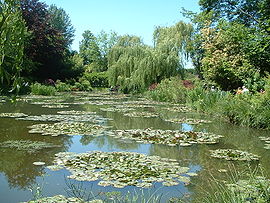
Giverny (French pronunciation: ​[ʒi.vɛʁ.ni]) is a commune in the Eure department in northern France. It is best known as the location of Claude Monet's garden and home.
 
Water lilies in Claude Monet's garden in Giverny 


A settlement has existed in Giverny since neolithic times and a monument uncovered attests to this fact. Archeological finds have included booties dating from Gallo-Roman times and to the earlier 1st and 2nd centuries AD. The town was known in ancient deeds as "Warnacum". The cultivation of grapes has been an occupation of the inhabitants of Giverny since Merovingian times. The village church dates from the Middle Ages and is built partially in the Romanesque style, though additions have since been made. It is dedicated to Sainte-Radegonde. The village has remained a small rural setting with a modest population (numbering around 301 in 1883 when Monet discovered it) and has since seen a boom in tourism since the restoration of Monet's house and gardens.


7. Arc de Triomphe

The Arc de Triomphe de l'Étoile (French pronunciation: ​[aʀk də tʀiɔ̃f də letwal], Arch of Triumph of the Star) is one of the most famous monuments in Paris. It stands in the centre of the Place Charles de Gaulle (originally named Place de l'Étoile), at the western end of the Champs-Élysées.[3] It should not be confused with a smaller arch, the Arc de Triomphe du Carrousel, which stands west of the Louvre. The Arc de Triomphe (in English: "Triumphal Arch") honours those who fought and died for France in the French Revolutionary and the Napoleonic Wars, with the names of all French victories and generals inscribed on its inner and outer surfaces. Beneath its vault lies the Tomb of the Unknown Soldier from World War I.

Arc de triomphe Paris.jpg


The Arc de Triomphe is the linchpin of the Axe historique (historic axis) – a sequence of monuments and grand thoroughfares on a route which runs from the courtyard of the Louvre to the Grande Arche de la Défense. The monument was designed by Jean Chalgrin in 1806 and its iconographic program pitted heroically nude French youths against bearded Germanic warriors in chain mail. It set the tone for public monuments, with triumphant patriotic messages.
The monument stands 50 metres (164 ft) in height, 45 m (148 ft) wide and 22 m (72 ft) deep. The large vault is 29.19 m (95.8 ft) high and 14.62 m (48.0 ft) wide. The small vault is 18.68 m (61.3 ft) high and 8.44 m (27.7 ft) wide. Its design was inspired by the Roman Arch of Titus. The Arc de Triomphe is built on such a large scale that, three weeks after the Paris victory parade in 1919 (marking the end of hostilities in World War I), Charles Godefroy flew his Nieuport biplane through it, with the event captured on newsreel.[4][5][6]
It was the tallest triumphal arch in existence until the completion of the Monumento a la Revolución in Mexico City in 1938, which is 67 metres (220 ft) high. The Arch of Triumph in Pyongyang, completed in 1982, is modelled on the Arc de Triomphe and is slightly taller at 60 m (197 ft).


Friday, November 28, 2014

7 Wonders of Africa

1. Nile river

Traversier Nil (2).JPG

The Nile (Arabic: النيل‎, Eg. en-Nīl, Std. an-Nīl; Coptic: ⲫⲓⲁⲣⲱ, P(h)iaro; Ancient EgyptianḤ'pī and Iteru) is a major north-flowing river in northeastern Africa, generally regarded as the longest river in the world.[2] It is 6,853 km (4,258 miles) long. The Nile is an "international" river as its water resources are shared by eleven countries, namely, Tanzania, Uganda, Rwanda, Burundi, Democratic Republic of the Congo, Kenya, Ethiopia, Eritrea, South Sudan, Sudan and Egypt.[3] In particular, the Nile is the primary water source of Egypt and Sudan.[4]


The Nile has two major tributaries, the White Nile and Blue Nile. The White Nile is considered to be the headwaters and primary stream of the Nile itself. The Blue Nile, however, is the source of most of the water and fertile soil. The White Nile is longer and rises in the Great Lakes region of central Africa, with the most distant source still undetermined but located in either Rwanda or Burundi. It flows north through Tanzania, Lake Victoria, Uganda and South Sudan. The Blue Nile (Amharic: ዓባይ?, ʿĀbay[5][6]) begins at Lake Tana in Ethiopia[7] and flows into Sudan from the southeast. The two rivers meet near the Sudanese capital of Khartoum.
The northern section of the river flows northwards almost entirely through the Sudanese desert to Egypt then ends in a large delta that empties into the Mediterranean Sea. Egyptian civilization and Sudanese kingdoms have depended on the river since ancient times. Most of the population and cities of Egypt lie along those parts of the Nile valley north of Aswan, and nearly all the cultural and historical sites of Ancient Egypt are found along riverbanks.


2. Okavango Delta 

 Thap okavango delta.JPG

The Okavango Delta (or Okavango Grassland) in Botswana is a very large inland delta formed where the Okavango River reaches a tectonic trough in the central part of the endorheic basin of the Kalahari. All the water reaching the Delta is ultimately evaporated and transpired, and does not flow into any sea or ocean. Each year approximately 11 cubic kilometres of water spreads over the 6,000-15,000 km² area. Some flood-waters drain into Lake Ngami.[1] The Moremi Game Reserve, a National Park, is on the eastern side of the Delta. This statistical significance helped the Okavango Delta secure a position as one of the Seven Natural Wonders of Africa, which were officially declared on February 11, 2013 in Arusha, Tanzania.[2] On the 22nd June, 2014, the Okavango Delta became the 1000th site to be officially inscribed on the UNESCO World Heritage List.[3][4]


The area was once part of Lake Makgadikgadi, an ancient lake that mostly dried up by the early Holocene. Although the Okavango Delta is widely believed to be the world's largest inland delta, it is not. In Africa alone there are two larger similar geological features: the Sudd on the Nile in South Sudan, and the Inner Niger Delta in Mali.


3. Ngorongoro Crater 


The Ngorongoro Conservation Area (NCA) is a conservation area and a UNESCO World Heritage Site located 180 km (110 mi) west of Arusha in the Crater Highlands area of Tanzania. Ngorongoro Crater, a large volcanic caldera within the area, is recognized by one private organization as one of the Seven Natural Wonders of Africa.[3] The conservation area is administered by the Ngorongoro Conservation Area Authority, an arm of the Tanzanian government, and its boundaries follow the boundary of the Ngorongoro Division of the Arusha Region. It has been reported in 2009 that the government authority has proposed a reduction of the population of the conservation area from 65,000 to 25,000.


There are plans being considered for 14 more luxury tourist hotels, so people can access "the unparalleled beauty of one of the world's most unchanged wildlife sanctuaries", however, the people who own the land have had few benefits from tourism. None of the senior level positions in the Ngorongoro Conservation Area are yet held by a member of the local Maasai pastoralists, who, in 2013, were aided by an international Avaaz campaign from being evicted from pastures bordering Serengeti National Park in order to facilitate the interests of a private luxury safari company.


4. Serengeti


The Serengeti (/ˌsɛrənˈɡɛti/) ecosystem is a geographical region in Africa. It is located in north Tanzania and extends to south-western Kenya between latitudes 1 and 3 degrees south latitude and 34 and 36 degrees east longitude. It spans approximately 30,000 km2 (12,000 sq mi). The Kenyan part of the Serengeti is known as Maasai Mara.
The Serengeti hosts the largest terrestrial mammal migration in the world, which helps secure it as one of the Seven Natural Wonders of Africa[1] and one of the ten natural travel wonders of the world.[2] The Serengeti is also renowned for its large lion population and is one of the best places to observe prides in their natural environment.[3] The region contains the Serengeti National Park in Tanzania and several game reserves.
Approximately 70 larger mammal and 500 avifauna species are found there. This high diversity is a function of diverse habitats, including riverine forests, swamps, kopjes, grasslands, and woodlands.[4] Blue wildebeests, gazelles, zebras, and buffalos are some of the commonly found large mammals in the region.
There has been controversy about a proposed road to be built through the Serengeti.[5]
Serengeti is derived from the Maasai language, Maa; specifically, "Serengit" meaning "Endless Plains".


History

Much of the Serengeti was known to outsiders as Maasailand. The Maasai are known as fierce warriors and live alongside most wild animals with an aversion to eating game and birds, subsisting exclusively on their cattle. Historically, their strength and reputation kept the newly arrived Europeans from exploiting the animals and resources of most of their land. A rinderpest epidemic and drought during the 1890s greatly reduced the numbers of both Maasai and animal populations. The Tanzanian government later in the 20th century re-settled the Maasai around the Ngorongoro Crater. Poaching and the absence of fires, which had been the result of human activity, set the stage for the development of dense woodlands and thickets over the next 30–50 years. Tsetse fly populations now prevented any significant human settlement in the area.
By the mid-1970s, wildebeest and the Cape buffalo populations had recovered and were increasingly cropping the grass, reducing the amount of fuel available for fires.[8] The reduced intensity of fires has allowed Acacia to once again become established.


5. Sahara Desert


The Sahara (Arabic: الصحراء الكبرى‎, aṣ-Ṣaḥrāʾ al-Kubrā , 'the Great Desert') is the largest subtropical hot desert and third largest desert after Antarctica and the Arctic.[1] At over 9,400,000 square kilometres (3,600,000 sq mi), it covers most of North Africa, making it almost as large as China or the United States. The Sahara stretches from the Red Sea to the east, including parts of the Mediterranean coasts to the Atlantic Ocean to the west. To the south, it is delimited by the Sahel, a belt of semi-arid tropical savanna that composes the northern region of central and western Sub-Saharan Africa.
Some of the sand dunes can reach 180 metres (590 ft) in height.[2] The name comes from the plural Arabic language word for desert (صحارى ṣaḥārā [3][4] [ˈsˤɑħɑːrɑː]).


Climate

The Sahara is a harsh environment with extreme conditions. It is the world's largest subtropical hot desert, and the world's hottest desert. The Sahara has mainly a subtropical, hot desert climate (Köppen climate classification BWh) with long, prolonged, extremely hot to scorching summers while the winters stay short, brief, extremely warm to truly very hot. The climate of this desert is also characterized by a perpetual clear sky, fair weather and by very low, and even almost non-existent rainfall but the precipitation is also very irregular and sporadic. Although the Sahara is located under the Tropic of Cancer in the most part, this climate is said to be subtropical due to the subtropical high pressure belt, which is mainly responsible of the hot desert climate. The northern fringe of the Great Desert receives very low winter rainfall, where low pressure systems associated with the polar front arrive as being very weak and very attenuated. The southern fringe of the Great Desert receives summer irregular rainfall but relatively low which can only occur when the Intertropical Convergence Zone moves up far enough northerly or when the tropical low pressure systems are strong enough to cause precipitation. In both cases, the climate is very arid and the rainfall only occur on a few days per year. Between the two parts, the central Sahara has an extremely arid climate, with the influence of the continental trade wind. The western coastal desert zone bask under the cool ocean current, the Canary Current which is responsible of a higher clouds and fog formation. According to the dryness of the air, the climate of the Sahara can not not be extreme, since any place where visible and invisible cloud cover as well as the water vapor contained within the atmosphere don't act as temperature regulator, the day between sunlight and ground in order to reduce the roasting, and the night between the Earth surface and space in order to reduce cooling process by sending the absorbed infrared radiation of contracted heat during the day towards the sky, any place having that feature will be characterized by large temperature variations and therefore by an extreme climate. The climates of the Sahara possess relatively high diurnal temperature ranges (between days and nights), and in some rare cases, brutal temperatures variations due to the extremely dry and pure air as well as the clarity of the desert skies. The presence of slow but constant winds make the dryness and the aridity of the Sahara even worse, by enabling a greater evaporation. The climate oscillates between the extreme heat during a typical summer day and the coolness of the winter nights. This desert is noted for his weather and climate extremes : indeed the Sahara contains the places, making part of the hottest, driest and sunniest places found in the entire world. The climate has mainly oppressively hot, sunny, windy and dry conditions all year long. The Sahara is the perfect model of the hot deserts as well as their climate. Carl Ritter liked to say that the Sahara was "the South of the World". This apparently paradoxical reflection means that the Sahara was the hottest and the driest region on Earth. The annual mean temperature of the Great Desert, reduced to the sea level is higher than the one of all other deserts found on the planet.


6. Mount Kilimanjaro 

Mount Kilimanjaro.jpg 

Mount Kilimanjaro /ˌkɪlɪmənˈɑːr/,[5] with its three volcanic cones, Kibo, Mawenzi and Shira, is a dormant volcanic mountain in Tanzania. It is the highest mountain in Africa and the highest free-standing mountain in the world at 5,895 metres (19,341 ft) above sea level

Geology
Kilimanjaro is a large stratovolcano and is composed of three distinct volcanic cones: Kibo, the highest; Mawenzi at 5,149 metres (16,893 ft);[6] and Shira, the shortest at 4,005 metres (13,140 ft).[7] Uhuru Peak is the highest summit on Kibo's crater rim. Tanzania National Parks, a governmental agency,[1] and the United Nations Educational, Scientific and Cultural Organization[2] list the height of Uhuru Peak as 5,895 m (19,341 ft). That height is based on a British Ordnance Survey in 1952.[8] Since then, the height has been measured as 5,892 metres (19,331 ft) in 1999, 5,891 metres (19,327 ft) in 2008, and 5,888 metres (19,318 ft) in 2014.[8]
Mawenzi and Shira are extinct, while Kibo is dormant and could erupt again. The last major eruption has been dated to between 150,000 and 200,000 years ago.[9] Kibo has gas-emitting fumaroles in its crater.
Several collapses and landslides have occurred on Kibo before, one creating the area known as the Western Breach.


7. Red Sea Reef


Red sea-reef 3539.jpg

The Red Sea, or what is sometimes called the Erythraean Sea, is a seawater inlet of the Indian Ocean, lying between Africa and Asia. The connection to the ocean is in the south through the Bab el Mandeb strait and the Gulf of Aden. In the north, there is the Sinai Peninsula, the Gulf of Aqaba, and the Gulf of Suez (leading to the Suez Canal). The Red Sea is a Global 200 ecoregion. The sea is underlain by the Red Sea Rift which is part of the Great Rift Valley.
The Red Sea has a surface area of roughly 438,000 km² (169,100 mi²).[1][2] It is about 2250 km (1398 mi) long and, at its widest point, 355 km (220.6 mi) wide. It has a maximum depth of 2211 m (7254 ft) in the central median trench, and an average depth of 490 m (1,608 ft). However, there are also extensive shallow shelves, noted for their marine life and corals. The sea is the habitat of over 1,000 invertebrate species, and 200 soft and hard corals. It is the world's northernmost tropical sea.