As of this blog theme Picture information gives some information on the
Pictures is a mainstay. this time it went on from the 7 wonders of
Indonesia this time I display the 7 wonders of China, quoted from
various sources and history, just:
A. Great Wall of China (Great Wall)

Great
Wall of China or the Great Wall of China, also known in China as long
as 10 000 Li Wall ¹ is building the longest man-made, located in the
People's Republic of China. Great Wall of China is not a continuous
length, but a collection of short walls that follow the shape of the
mountains of northern China. [6] On April 18, 2009 [7], after an
investigation by the government accurately the People's Republic of
China, announced that a giant wall constructed the period of the Ming
dynasty is 8851 km in length. According to historical records, after a
long wall built by the Ming, then the term is "Changcheng" (长城, "great
wall" or "long wall"). [3] Previously the term was not found. [3] The
term Great Wall of China in Mandarin is the "Wanli Changcheng", meaning
"wall that extends 10 thousand li". [3] At the present time the term is
officially used.
2. Forbidden City (city limits)

After China's famous Great Wall there is one more amazing is the
Forbidden City (The Forbidden City) or in a language called Zijin Cheng
China, which have been loaded in the colossal movie "The Last Emperor"
was released in 1987. Splendor and magical impression that emerges from
the film leaves the impression of a dream kingdom and return to the
past. UNESCO sites recorded in 1987 as one of the world heritage stands
majestically in an area of 720 000 m2, consists of 980 buildings, with
8707 rooms - which supposedly was once the residence of the emperor's
concubines. The palace complex was built in 1406 and was completed in
1420. but thrown into the past, your eyes will be satisfied by the
beauty of traditional Chinese buildings - a very powerful form of
architecture affects not only the cultures of East Asia community. The
only wealth that may never be able to trace the heritage of art and
historical artifacts stored in the Forbidden City is now also known as
the Palace Museum. According to the manager, the collection has reached
1.17 million items. Although most of these collections are also stored
in the National Palace Museum, Taipei.
3. Terracotta Army

Terracotta
Army are the statues of soldiers and horses found in the Tomb of the
First Emperor of China, Qin Shi Huang. Terracotta Army was discovered in
1974 by several local farmers near Xi'an, Shaanxi Province. The number
of the statues were estimated at more than 8,000 soldiers, 130 trains
with 520 horses and 150 cavalry horses, most of which are still buried
in a lot of holes. The archaeologists believe that there are many holes
that are still waiting to be discovered.
Buried in the soil since 210 BC, served as the Terracotta Army "occult
forces" guard the tomb of the emperor. Emperor Qin Shi Huang, brilliant
at once cruel ruler of unifying China and the builder of the Great Wall
of China first, allegedly seized with paranoia and ambition to stay in
power even in the afterlife, as he came to power in the world.
Inevitably, around the giant tomb mounds, which until now has remained
closed, the holes tunnel hides the unseen world other state officials,
soldiers, chariots, horses, entertainers, and musicians.
This discovery reveals a big secret in the history of China, and also
pave the way for the greatest archeological discoveries of all time.
And, by assembling the history and experience first-hand from his
travels in China, John Man tells the history of the history of how and
why that marvelous artifacts are created in the 3rd century BC.
All this leads to a single figure, the First Emperor, which converts
China from states that fought each other to be a great nation as it is
now. That's the amazing achievements of one of the great individual in
history, which combines the vision, leadership, and cruelty to unite the
enemies. Manufacturing of the Terracotta Army completely finished with
less than ten years (230-221 BC), believed by many decades as the most
important era through 5,000 years of Chinese history.
4. Hanging Temple (Hanging Monastery)
Along with the Yungang Grottoes, the Hanging Monastery is one of the main tourist attractions and historical sites in the Datong area. Hanging Monastery is a great place to start the day traveling around the Heng Shan, a mountain which is endowed with a wealth of temples, historic sites and natural beauty.

In the Tuoba 386 Turkish people take advantage of hard times in China to
establish their own dynasty, Wei north, and then take the Datong as
their capital. Although this is a very turbulent time in Chinese
history, Wei became a devout Buddhist, and some important cultural site
was built during the reign of their relatively short. Hanging Monastery
was built in 491 and has survived over 1400 years.
Hanging Temple, Datong
A second period of greatness came with the arrival of Mongol Liao
dynasty, also Buddhists, who made Datong their capital in 907.
Incorporated into the Jin in 1125, Liao leaving a small legacy of
sculptures and some fine temple architecture, especially the central
temple Huayan (Huayan Si) and a wooden pagoda (Yingxian Mu Ta), the
oldest in China, in the nearby town Yingxian. Datong remained important
for the later Chinese dynasties for its strategic position right on the
Great Wall, south of Inner Mongolia, and the high walls of the city
dates from the early Ming Dynasty.
The monastery still largely rebuilt and restored under successive
dynasties to the Ming Dynasty (1368-1644) and Qing Dynasty (1644-1911).
The temples are still a feat of engineering. Buddhist marvel of
engineering that not only defy the laws of gravity are also religious.
Instead of a special devotion to a single religion, the Hanging
Monastery distinguishes itself from other temples to include respect for
Taoism, Confucianism, and Buddhism. A unique mechanical theory applied
to build the framework. Latitude of the half put into the stone as a
base, while the stone behind a support. Hanging Monastery appears to be
falling, like a floating monastery. Construction experts from countries
including Britain, Germany, and Italy, came to see the monastery. With
their words, Hanging Monastery, which mixes mechanics, aesthetics, and
Buddhism, is rare. Monastery and everything that symbolizes embodies a
great cultural achievements of the Chinese people. Today, the Hanging
Monastery attract more visitors and more around the world will marvel at
this temple.
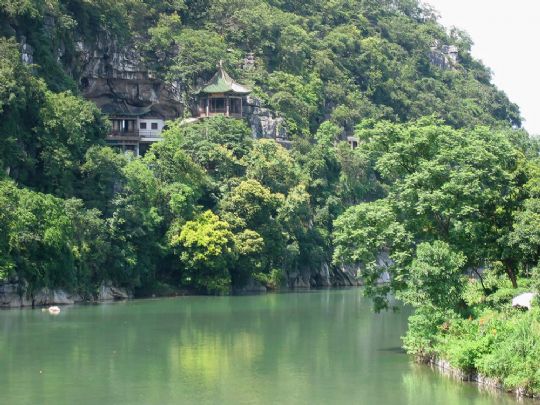
5. Seven Star Park
Seven Star Park got its name from seven peaks which should resemble the
pattern of stars near the Big Dipper constellation, four peaks in the
north called Putuo Hill and three in the south called the Lunar Hill.
Seven Stars famous cave is located in Mount Putuo.
Seven Star Park, Guilin
It has been popular since the Sui (581-618) and (618-907) Tang Dynasty.
The main sights contain Flower Bridge, Putuo Mountain, Seven Stars Cave,
Camel Hill, Crescent Mountain, Guihai Stele Forest and Light of China
Square.

Flower Bridge, built in the Song Dynasty (960-1279), is the oldest
bridge in Guilin. Every spring and summer, he set out with flowers
blooming and the river, then the name of the Flower Bridge.
An important feature of the Mount Crescent is 200 calligraphy carvings
in the caves in it. This is said to be an important and talented work of
calligraphy from the Tang (618-907 AD), Ming (1368-1644 AD) and Qing
(1644-1911 AD) Dynasties. In the park, there is a view Karst, including
caves and rocks. Dates back 1000 years ago, where it has become an
attractive place for local people.
6. Tiger Hill Pagoda

Tiger Hill Pagoda or Pagoda Yunyan standing on top of the hill is part of the Temple Yunyan. As the oldest pagoda in Suzhou, it serves as a landmark city, was built during the late period of the Five Dynasties (907-959) and was completed in the second year of the Song Dynasty (959-961).
Tiger Hill Pagoda, Suzhou
It was built earlier and higher than the Leaning Tower of Pisa. Was
originally built of wood, the structure of the complex, colorful and
majestic with a unique style. The tower height is 48m, built with bricks
laying eight cornered on the seventh floor. In more than a thousand
years the tower has gradually slanted due to the forces of nature. It
rests about 3.5 degrees north.
In 1957, efforts were made to stabilize and prevent further leaning
tower. Concrete is also pumped into the ground to form a stronger
foundation. During the process of strengthening, a stone coffin
containing Buddhist scriptures were found.
Also the tower partially repaired in 1981 by local governments. Concrete
piles have been driven into the ground around the pagoda to strengthen
the foundation. As many Tang pagoda and the early Song period, it is a
contemporary wood imitation stone pagoda. The "brackets" and "threshold"
carved on the surface is not structural, but decorative.
Today pagoda 1000 year has been a symbol of Suzhou. And it is listed as
one of the special historical sites under State protection. Temple was
the highest point on the hill and has a magnificent view.
7. Yuyuan Garden
The park is believed to originate from the 16th century when Zhang
Nanyang, architect, was commissioned by the family of a special Pan by
Pan Ming court Yunduan build garden in honor of his father Pan En. The
garden was reportedly first established in 1559 as a private garden,
construction took nearly 20 years.
Yuyuan Garden in Shanghai

Yu
Yuan Garden is an enclave of traditional Chinese architecture and
classical gardens. One of the most popular tourist attractions in
Shanghai, Yu Yuan Garden is worth a visit to the garden and tea house,
especially if you do not get a chance to go to a park near the cities of
Suzhou and Hangzhou. But lovely as it is, the right attraction for many
who visit the Yu Yuan Garden is a huge bazaar that stretches from the
central area and the entrance to the park, to the outskirts of the local
environment. Here, great bargains on all sorts of things that can be
found, from embroidered slippers, a "new" antique, lucky charms, fake
paper money to burn for the ghost of your ancestors', umbrellas, and
other knickknacks.
No comments:
Post a Comment