Monday, November 17, 2014

7 wonders of spain building

1. Mosque–Cathedral of Córdoba

Mezquita de Córdoba desde el aire (Córdoba, España).jpg 

The Mosque-cathedral of Córdoba (Spanish: Mezquita–catedral de Córdoba), known as the Mosque of Córdoba (Spanish: Mezquita de Córdoba), whose ecclesiastical name is the Cathedral of Our Lady of the Assumption (Spanish: Catedral de Nuestra Señora de la Asunción), is the Catholic Christian cathedral of the Diocese of Córdoba dedicated to the Assumption of the Virgin Mary and located in the Spanish region of Andalusia. It originally was a Catholic Christian church built by the Visigoths,although it was later converted to an Islamic mosque in the Middle Ages; after the Reconquista, it was made a Catholic Christian church once again. The cathedral is regarded as one of the most accomplished monuments of Moorish architecture. Since the early 2000s, Spanish Muslims have lobbied the Roman Catholic Church to allow them to pray in the cathedral.This Muslim campaign has been rejected on multiple occasions, both by the church authorities in Spain and by the Vatican.


2. Seville Cathedral


The Cathedral of Saint Mary of the See (Spanish: Catedral de Santa María de la Sede), better known as Seville Cathedral, is a Roman Catholic cathedral in Seville (Andalusia, Spain). It is the largest Gothic cathedral and the third-largest church in the world. It is also the largest cathedral in the world, as the two larger churches, the Basilica of the National Shrine of Our Lady of Aparecida and St Peter's Basilica, are not the seats of bishops. It was registered in 1987 by UNESCO as a World Heritage Site, along with the Alcázar palace complex and the General Archive of the Indies.
After its completion in the early 16th century, the Seville Cathedral supplanted Hagia Sophia as the largest cathedral in the world, a title the Byzantine church had held for nearly a thousand years. The cathedral is also the burial site of Christopher Columbus. The Archbishop's Palace is located on the northeastern side of the cathedral.

3.Alhambra


Alhambra (/ælˈhæmbrə/; Spanish: [aˈlambɾa]; Arabic: الْحَمْرَاء‎, [ʔælħæmˈɾˠɑːʔ], Al-Ḥamrā', lit. "the red one"),[a] the complete form of which was Calat Alhambra, is a palace and fortress complex located in Granada, Andalusia, Spain. It was originally constructed as a small fortress in 889 and then largely ignored until its ruins were renovated and rebuilt in the mid-11th century by the Moorish emir Mohammed ben Al-Ahmar of the Emirate of Granada, who built its current palace and walls. It was converted into a royal palace in 1333 by Yusuf I, Sultan of Granada.
A room of the palace and a view of the Court of the Lions.
Alhambra's Islamic palaces, as we know them today, were built for the last Muslim emirs in Spain and the court of the Nasrid dynasty. After the conquest of Granada by the Reyes Católicos ("Catholic Monarchs") in 1492, some portions were used by Christian rulers. The Palace of Charles V, built by Charles V, Holy Roman Emperor in 1527, was inserted in the Alhambra within the Nasrid fortifications. After being allowed to fall into disrepair for centuries, the buildings being occupied by squatters, Alhambra was rediscovered in the 19th century by European scholars and travelers, with restorations commencing. It is now one of Spain's major tourist attractions, exhibiting the country's most significant and well known Islamic architecture, together with 16th-century and later Christian building and garden interventions. Alhambra is a UNESCO World Heritage Site and the inspiration for many songs and stories.
Moorish poets described it as "a pearl set in emeralds," an allusion to the colour of its buildings and the woods around them. The palace complex was designed with the mountainous site in mind and many forms of technology were considered. The park (Alameda de la Alhambra), which is overgrown with wildflowers and grass in the spring, was planted by the Moors with roses, oranges, and myrtles; its most characteristic feature, however, is the dense wood of English elms brought by the Duke of Wellington in 1812. The park has a multitude of nightingales and is usually filled with the sound of running water from several fountains and cascades. These are supplied through a conduit 8 km (5.0 mi) long, which is connected with the Darro at the monastery of Jesus del Valle above Granada. 
Despite long neglect, willful vandalism, and some ill-judged restoration, Alhambra endures as an atypical example of Muslim art in its final European stages, relatively uninfluenced by the direct Byzantine influences found in the Mezquita of Córdoba. The majority of the palace buildings are quadrangular in plan, with all the rooms opening on to a central court, and the whole reached its present size simply by the gradual addition of new quadrangles, designed on the same principle, though varying in dimensions, and connected with each other by smaller rooms and passages. Alhambra was extended by the different Muslim rulers who lived in the complex. However, each new section that was added followed the consistent theme of "paradise on earth". Column arcades, fountains with running water, and reflecting pools were used to add to the aesthetic and functional complexity. In every case, the exterior was left plain and austere. Sun and wind were freely admitted. Blue, red, and a golden yellow, all somewhat faded through lapse of time and exposure, are the colors chiefly employed.

 
"Detail of the script of the wall of the Mexuar Hall: "God is the only Victor.".

The decoration consists, as a rule, of Arabic inscriptions that are manipulated into geometrical patterns wrought into arabesques. Painted tiles are largely used as panelling for the walls. The palace complex is designed in the Mudéjar style, which is characteristic of western elements reinterpreted into Islamic forms and widely popular during the so-called Reconquista, the "reconquest" of the Iberian Peninsula from the Muslims by the Christian kingdoms.


4.Basilica of Our Lady of the Pillar


The Basilica–Cathedral of Our Lady of the Pillar (Spanish: Catedral-Basílica de Nuestra Señora del Pilar) is a Roman Catholic church in the city of Zaragoza, Aragon, Spain. The Basilica venerates Blessed Virgin Mary, under her title Our Lady of the Pillar praised as Mother of the Hispanic Peoples by Pope John Paul II.[2] It is reputed to be the first church dedicated to Mary in history.
Local traditions take the history of this basilica to the dawn of Christianity in Spain attributing to an apparition to Saint James the Great, the apostle who is believed by tradition to have brought Christianity to the country.[4] This is the only reported apparition of Mary to have occurred before her believed Assumption.
Basilica del Pilar ZaragozaAragon(Spain).jpgMany of the kings of Spain, many other foreign rulers and saints have paid their devotion before this statue of Mary. Saint John of the Cross, Saint Teresa of Ávila, Saint Ignatius of Loyola, and Blessed William Joseph Chaminade are among the foremost ones. The Basilica of Our Lady of the Pillar is one of two minor basilicas in the city of Zaragoza, and is co-cathedral of the city alongside the nearby La Seo Cathedral. The architecture is of Baroque style, and the present building was predominantly built between 1681 and 1872.

5. Roman Theatre (Mérida)

Merida Roman Theatre1.jpg

The Roman Theatre of Mérida is a construction promoted by the consul Vipsanius Agrippa in the Roman city of Emerita Augusta, capital of Lusitania (current Mérida, Spain). It was constructed in the years 16 to 15 BCE.
The theater has undergone several renovations, notably at the end of the 1st century or early 2nd century CE (possibly during the reign of Emperor Trajan), when the current facade of the scaenae frons was erected, and another in the time of Constantine I (between 330 and 340) which introduced new decorative-architectural elements and a walkway around the monument. Following the theatre's abandonment in Late Antiquity, it was slowly covered with earth, with only the upper tiers of seats (summa cavea) remaining visible. In local folklore the site was referred to as "The Seven Chairs", where, according to tradition, several Moorish kings sat to decide the fate of the city.


6. Santiago de Compostela Cathedral

Basílica de Santiago 02.JPG 

The Cathedral of Santiago de Compostela (Galician: Catedral de Santiago de Compostela), a cathedral of the archdiocese is in the World Heritage Site of Santiago de Compostela in Galicia in Spain. The cathedral is the reputed burial-place of Saint James the Great, one of the apostles of Jesus Christ. The cathedral has historically been a place of pilgrimage on the Way of St. James, since the Early Middle Ages. The building is a Romanesque structure with later Gothic and Baroque additions.

7. Sagrada Família

Sagrada Familia 01.jpg 

The Basílica i Temple Expiatori de la Sagrada Família (Catalan pronunciation: [səˈɣɾaðə fəˈmiɫiə]; English: Basilica and Expiatory Church of the Holy Family), is a large Roman Catholic church in Barcelona, Spain, designed by Catalan architect Antoni Gaudí (1852–1926). Although incomplete, the church is a UNESCO World Heritage Site, and in November 2010 Pope Benedict XVI consecrated and proclaimed it a minor basilica, as distinct from a cathedral which must be the seat of a bishop.
Construction of Sagrada Família had commenced in 1882 and Gaudí became involved in 1883, taking over the project and transforming it with his architectural and engineering style, combining Gothic and curvilinear Art Nouveau forms. Gaudí devoted his last years to the project, and at the time of his death at age 73 in 1926 less than a quarter of the project was complete. Sagrada Família's construction progressed slowly, as it relied on private donations and was interrupted by the Spanish Civil War, only to resume intermittent progress in the 1950s. Construction passed the midpoint in 2010 with some of the project's greatest challenges remaining and an anticipated completion date of 2026, the centenary of Gaudí's death.
The basílica has a long history of dividing the citizens of Barcelona: over the initial possibility it might compete with Barcelona's cathedral, over Gaudí's design itself, over the possibility that work after Gaudí's death disregarded his design, and the recent proposal to build an underground tunnel of Spain's high-speed rail link to France which could disturb its stability.
Describing Sagrada Família, art critic Rainer Zerbst said, "It is probably impossible to find a church building anything like it in the entire history of art" and Paul Goldberger called it, "The most extraordinary personal interpretation of Gothic architecture since the Middle Ages."


7 wonders of Germany building

1. Dresden Frauenkirche


The Dresden Frauenkirche (German: Dresdner Frauenkirche, IPA: [ˈfʁaʊənˌkɪʁçə], Church of Our Lady) is a Lutheran church in Dresden, the capital of the German state of Saxony. Although the original church was Roman Catholic until it became Protestant during the Reformation, the current Baroque building was purposely built Protestant. It is considered an outstanding example of Protestant sacred architecture, featuring one of the largest domes in Europe.
Frauenkirche bei Nacht.jpgBuilt in the 18th century, the church was destroyed in the bombing of Dresden during World War II. The remaining ruins were left as a war memorial, following decisions of local East German leaders. The church was rebuilt after the reunification of Germany. The reconstruction of its exterior was completed in 2004 and its interior in 2005. The church was reconsecrated on 30 October 2005 with festive services lasting through the Protestant observance of Reformation Day on 31 October. It now also serves as symbol of reconciliation between former warring enemies. The surrounding Neumarkt square with its many valuable baroque buildings is also reconstructed since 2004.
The Frauenkirche is often called a cathedral, however it is not the seat of a bishop. The bishop's church is the Church of the Cross. Once a month, an Anglican Evensong is held in English, by clergy from the St. George's Anglican Chaplaincy.


2. Holsten Gate

The Holsten Gate ("Holstein Tor", later "Holstentor") is a city gate marking off the western boundary of the old center of the Hanseatic city of Lübeck. This Brick Gothic construction is one of the relics of Lübeck’s medieval city fortifications and the only remaining city gate, except for the Citadel Gate ("Burgtor"). Because its two round towers and arched entrance are so well known it is regarded today as a symbol of this German city, and together with the old city centre (Altstadt) of Lübeck it has been a UNESCO World Heritage Site since 1987.


 Modern reproduction of a cannon in the Holsten Gate


 3. Cologne Cathedral

Kölner Dom 2013-06-06-01.JPG 

Cologne Cathedral (Kölner Dom) (Latin: Ecclesia Cathedralis Sanctorum Petri et Mariae, officially Hohe Domkirche St. Petrus, English: High Cathedral of St. Peter) is a Roman Catholic church in Cologne, Germany. It is the seat of the Archbishop of Cologne and the administration of the Archdiocese of Cologne. It is a renowned monument of German Catholicism and Gothic architecture and is a World Heritage Site.It is Germany's most visited landmark, attracting an average of 20,000 people a day.
Construction of Cologne Cathedral commenced in 1248 and was halted in 1473, leaving it unfinished. Work restarted in the 19th century and was completed, to the original plan, in 1880. It is 144.5 metres (474 ft) long, 86.5 m (284 ft) wide and its towers are approximately 157 m (515 ft) tall. The cathedral is the largest Gothic church in Northern Europe and has the second-tallest spires (after Ulm Minster. See info-box below.) Its two huge spires give it the largest façade of any church in the world. The choir has the largest height to width ratio, 3.6:1, of any medieval church.
Cologne's medieval builders had planned a grand structure to house the reliquary of the Three Kings and fit its role as a place of worship for the Holy Roman Emperor. Despite having been left incomplete during the medieval period, Cologne Cathedral eventually became unified as "a masterpiece of exceptional intrinsic value" and "a powerful testimony to the strength and persistence of Christian belief in medieval and modern Europe".

4.Neuschwanstein Castle


Schloss Neuschwanstein 2013.jpg 

Neuschwanstein Castle (German: Schloss Neuschwanstein, pronounced [nɔʏˈʃvaːnʃtaɪn], English: "New Swanstone Castle") is a nineteenth-century Romanesque Revival palace on a rugged hill above the village of Hohenschwangau near Füssen in southwest Bavaria, Germany. The palace was commissioned by Ludwig II of Bavaria as a retreat and as an homage to Richard Wagner. Ludwig paid for the palace out of his personal fortune and by means of extensive borrowing, rather than Bavarian public funds.
The palace was intended as a personal refuge for the reclusive king, but it was opened to the paying public immediately after his death in 1886. Since then more than 61 million people have visited Neuschwanstein Castle. More than 1.3 million people visit annually, with as many as 6,000 per day in the summer. The palace has appeared prominently in several movies and was the inspiration for Disneyland's Sleeping Beauty Castle and later, similar structures.

5.Moritzburg Castle


Moritzburg Castle (German: Schloss Moritzburg) is a Baroque palace in Moritzburg, in the German state of Saxony, about 13 kilometres (8.1 mi) northwest of the Saxon capital, Dresden. The castle has four round towers and lies on a symmetrical artificial island. It is named after Duke Moritz of Saxony, who had a hunting lodge built there between 1542 and 1546. The surrounding woodlands and lakes have been a favourite hunting area of the electors and kings of Saxony.

6. Charlottenburg Palace

Charlottenburg Hohenzollern 2.jpg

Charlottenburg Palace (German: Schloss Charlottenburg) is the largest palace in Berlin, Germany, and the only surviving royal residence in the city dating back to the time of the Hohenzollern family. It is located in the Charlottenburg district of the Charlottenburg-Wilmersdorf borough.
The palace was built at the end of the 17th century and was greatly expanded during the 18th century. It includes much exotic internal decoration in baroque and rococo styles. A large formal garden surrounded by woodland was added behind the palace, including a belvedere, a mausoleum, a theatre and a pavilion. During the Second World War, the palace was badly damaged but has since been reconstructed. The palace with its gardens are a major tourist attraction.


7. Reichstag building


Reichstag building Berlin view from west before sunset.jpg

Moritzburg Castle


Cologne Cathedral
Cologne Cathedral

The Reichstag building (German: Reichstagsgebäude; officially: Plenarbereich Reichstagsgebäude) is a historical edifice in Berlin, Germany, constructed to house the Imperial Diet (German: Reichstag), of the German Empire. It was opened in 1894 and housed the Diet until 1933, when it was severely damaged in a fire. After World War II, the building fell into disuse; the parliament of the German Democratic Republic (the Volkskammer) met in the Palast der Republik in East Berlin, while the parliament of the Federal Republic of Germany (the Bundestag) met in the Bundeshaus in Bonn.
The ruined building was made safe against the elements and partially refurbished in the 1960s, but no attempt at full restoration was made until after German reunification on 3 October 1990, when it underwent a reconstruction led by architect Norman Foster. After its completion in 1999, it once again became the meeting place of the German parliament: the modern Bundestag.
The term Reichstag, when used to connote a diet, dates back to the Holy Roman Empire. The building was built for the Diet of the German Empire, which was succeeded by the Reichstag of the Weimar Republic. The latter would become the Reichstag of Nazi Germany, which left the building (and ceased to act as a parliament) after the 1933 fire and never returned; the term Reichstag has not been used by German parliaments since World War II. In today's usage, the German word Reichstag (Imperial Diet Building) refers mainly to the building, while Bundestag (Federal Diet) refers to the institution.

from many source and wikipedia.


Wednesday, November 5, 2014

Untung dan Rugi Kenaikan Harga BBM BBM naik...... yes or no!!

Kenaikan Harga BBM memang diibaratkan dengan kenaikan harga-harga barang dan terutama harga barang pokok atau sembako didalam keseharian rumah tangga, yang dengan pemenuhan sembako itu haruslah sesuai dengan pendapatan dengan gaji atau penghasilan sehari-hari. Secara otomatis pemenuhan sembako berhubungan dengan nilai gizi baik dan gizi buruk masyarakat pada umumnya. Dengan BBM yang semakin melunjak naik keatas memang nilai pasar bahan bakar kendaraan menjadi naik dan dikatakan sampai mencapai Rp.1500- untuk setiap ongkos angkutan umum. Dengan kenaikan ongkos tersebut maka dengan otomatisnya biaya pengiriman membutuhkan ongkos yang lebih besar dari biasanya dan untuk supaya keungtungan dari perdagangan tidak menjadi rugi atau habis di ongkos kirim maka akhirnya socara otomatis barang-barang ditingkatkan harganya yang termasuk sembako sembilan bahan pokok, yang kemudian berdampak buruk dengan tidak terbelinya harga-harga oleh masyarakat yang kurang mampu pada umumnya. mereka berpikir beberapa kali untuk memilah dan memilih mana sembako yang cukup untuk disesuaikan dengan keadaan kantong mereka. Dengan kondisi seperti mungkin sembako yang nilai jualnya tinggi yaitu biasanya identik dengan giji baik seperti daging, susu, keju, bahkan nasi yang sumber pokok menjadi mahal dan menjadi suatu yang harus dihemat, padahal untuk hal seperti itu adalah fatal akibatnya bagi pertumbuhan anak bangsa dalam bidang gizi, terutama para balita yang wajib harus selalu mengkonsumsi susu setiap hari. Dan dengan hal-hal lain seperti barang-barang elektronik, furniture dll yang ikut naik, tetapi dengan pendapatan ataupun gaji para pegawai yang belum tetntu akan mendapatkan kenaikan serta yang mungkin akan berdampak buruk seperti para pekerja yang rumahnya jauh yang dihabiskan buat ongkos angkutan umum saja gajinya dipakai dan belum buat makan apalagi bergizi dan berimbang. BUkan itu saja bagi sistem yang lebih besar lagi contohnya perusahaan kecil ataupun menengah yang tidak mampu lagi membeli bahan-bahan produksi untuk di hasilkan, bahkan dengan barang-barang jadi naik tetapi laba masih tetap Contoh "dulu harga terigu misalnya Rp. 2500 dengan laba 300. nanti harga terigu naik jadi Rp. 2800 dengan laba tetap Rp.300. Sedangkan pendapatan dulu misal sejuta dan pengeluaran sejuta, nanti setelah bbm naik pendapatan sejuta pengeluaran dua juata bisa jadi, tetapi itu kembali pada keuletan masing-masing juga. Dari uraian diatas adalah kerugian-kerugian atau dampak dari harga BBM naik nah ini yang membuat dilema para pemikir yang mungkin memang ada untungnya bagi kita semua selain hal-hal diatas. seperti katanya pemerintah telah menyediakan fasilitas sebagai pengganti BBM. yang menjadi akar permasalahan adalah sudah adakah fasilitas itu? kalau dicontohkan seperti akan adanya transportasi ramah lingkungan tenaga matahari atau memakai battere, kompor-kompor listrik berkualitas dan aman yang tidak memerlukan BBM sama sekali. Dari pernyataan yang akan memberikan fasilitas-fasilitas tersebut memang menggiurkan selain ramah lingkungan mungkin persediaan bahan bakar minyak akan menjadi awet. karena untuk antisipasi bila sewaktu-waktu BBM didunia benar-benar mulai langka atau habis maka akan kerepotan yang benar-benar terjadi tanpa ancang-ancang terlebih dahulu. sedangkan hampir setiap hari kita beraktifitas menggunakan fasilitas BBM. nah mungkin dengan BBM naik ini bisa sedikit menjadi suatu pemikiran kita tersendiri yaitu dengan cara memakai sepeda kekantor dan kalau mungkin memakai mobil listrik atau tenaga matahari seperti di jepang, sekarang sudah beredar banyak sepeda listrik yang sudah dipakai oleh beberapa kalangan, tapi sepertinya kurang diminati. dilihat dari survei sendiri dengan alasan kurang logis karena "tidak gaya/keren" padahal untuk kekurangan dari sepeda listrik tersebut hanya harus rajin dicharger saja, untuk tingkat jarak jauh sepertinya masih bisa di modif atau dirancang untuk jarak jauh, dan padahal ketika habis battere kita tidak harus punya uang untuk beli bensin atau premium, tapi cukup dengan dicharge, serta masih ada pedal sepeda yang bisa digunakan. selain itu dunia sudah mulai terpolusi dan kerusakan alam karena pemakaian BBM itu sendiri. Sehari-hari sedikit demi sedikit bisa teratasi jauh dari polusi dan bisa menyelamatkan kadar Oksigen dunia juga, yang memang sudah berdampak global warming ini selain dengan penghijauan atau go Green. selain bisa berefek ramah lingkungan kenaikan BBM bisa menekan nilai dollar atau mata uang asing, tapi dengan syarat taraf hidup msayarakt harus ikut naik seperti misalnya gaji-gaji pegawai ditaikan 2 kali lipat. contohnya nilai dollar yang 1 dollarnya adalah 10.000 yang dibandingkan dari gaji sekarang 2 juta terbilang mahal, sehingga kalo orang perorang membeli dollar tidak sebanding dengan pendapatan. Beda lain halnya dengan gaji naik 2 kali lipat jadi 4 juta misalkan. Maka pembelian dollar menjadi lebih ringan. seperti halnya devisa negara yang misalnya punya utang 2 milyar dollar, dan pendapatan devisa misal 1 milyar dollar olehnya maka belum sebanding, nah diharapkan dengan BBM naik ya devisa juga harus ikut naik misalnya jadi 4 milyar dollar karena taraf hidup naik misalnya, dan diharapkan pun juga devisa negara harus terus naik. itu saja hal-hal keuntungan dan kerugian dari kenaikan BBM yang bisa tertuang di tulisan ini, dan diharapkan pemerintah untuk menindaklanjuti kenaikan BBM ini harus benar-benar disertai dengan solusinya terlebih dahulu seperti pengganti BBM yang bisa diandalkan dan tidak malah membuat rakyat menjadi tersungkur dan memprihatinkan. Dan untuk para masyarakat untuk tidak terpacu anarkis apalagi sampai merusak fasilitas-fasilitas yang itu semua milik rakyat sendiri, jadi seakan-akan berprotes ke pemerintah untuk rakyat tapi bisa merugikan rakyat yang lain. dan rakyat yang telah dirugikanpun bisa menjadi dilema apakah harus mendukung pemerintah dengan kenaikan BBM nya atau rakyat demo dengan anarkisnya. Dan itu semua kembali pada diri kita masing-masing untuk mengatasinya secara bijak. Pertanyaan kesimpulannya adalah apakah kita bisa maju tanpa harus BBM dinaikan?

Duduk Berjam-jam Setiap Hari Bisa Mematikan

Apakah Anda seorang pekerja kantoran yang selalu menghabiskan waktu di tempat duduk ? Jika jawabannya ya, Anda patut waspada. Riset terbaru menunjukkan, mereka yang menghabiskan waktunya dengan duduk selama 11 jam atau lebih, memiliki risiko 40 persen lebih besar meninggal dalam kurun waktu tiga tahun ke depan, terlepas dari apakah Anda aktif secara fisik atau tidak. Seperti yang dipublikasikan dalam jurnal Archives of Internal Medicine edisi 26 Maret, para peneliti dari Australia menyampaikan ancaman serius dari gaya hidup kurang aktif atau sedentari. Mereka menganalisis data lebih dari 222.000 orang berusia 45 tahun atau lebih tua. Hasil kajian mengindikasikan, risiko kematian seseorang cenderung melonjak ketika menghabiskan waktunya dengan duduk selama 11 jam setiap hari. Risiko ini 15 persen lebih tinggi jika dibandingkan dengan mereka yang duduk kurang dari 4 jam per hari. "Bukti mengenai efek buruk duduk terlalu lama terhadap kondisi kesehatan telah bermunculan selama beberapa tahun terakhir," kata peneliti studi, Hidde van der Ploeg, seorang peneliti senior dari University of Sydney. Dalam kajiannya, peneliti juga menemukan bahwa sebanyak 62 persen dari peserta penelitian mengaku memiliki berat badan yang berlebihan atau obesitas. Sementara itu, hampir 87 persen mengaku sedang berada dalam kondisi kesehatan yang baik, dan seperempat lainnya mengatakan menghabiskan setidaknya 8 jam untuk duduk setiap hari. Van der Ploeg menjelaskan, mereka yang duduk terlalu lama akan mengalami kenaikan risiko kematian hingga dua kali lipat dalam kurun waktu tiga tahun ke depan dibandingkan mereka yang jarang duduk atau bergaya hidup aktif. Sedangkan di antara orang dewasa yang tidak aktif dan duduk terlalu lama, risikonya sepertiga lebih besar meninggal ketimbang mereka yang jarang duduk. Dari penelitian juga terungkap, peserta rata-rata menghabiskan 90 persen waktu luangnya dengan duduk, dan kurang dari 50 persen yang memenuhi rekomendasi Organisasi Kesehatan Dunia (WHO) untuk melakukan aktivitas fisik selama 150 menit setiap minggunya. Oleh sebab itu, Van der Ploeg menyarankan pekerja kantoran untuk bergaya hidup lebih aktif. "Carilah cara untuk mengubah kebiasaan duduk yang terlalu lama. Cobalah untuk lebih banyak berdiri atau berjalan jika memungkinkan," ujarnya. Van der Ploeg mengakui keterbatasan temuannya tersebut. Ia menegaskan bahwa temuan ini tidak membuktikan hubungan sebab-akibat dan mengatakan perlu studi lebih lanjut untuk mereplikasi temuan dan lebih berfokus pada pengaruh duduk terhadap pengembangan kondisi seperti diabetes, kanker dan penyakit jantung. "Semua penelitian ini ke depannya akan menginformasikan kepada kami tentang hubungan yang tepat antara duduk dan kondisi kesehatan, yang pada akhirnya akan menghasilkan rekomendasi kesehatan masyarakat seperti yang sudah kita miliki seperti misalnya untuk aktivitas fisik," tutupnya. untuk mencari klik www.4shared.com www.rapidshare.com www.ziddu.com http://adf.ly/6UX8w www.google.com www.yahoo.com www.msn.com www.youtube.com www.facebook.com Download Lagu www.stafaband.com

Teknologi Terbaru : Meja Masa Depan

Sobat mungkin sudah sering melihat video maupun film yang menampilkan kecanggihan teknologi terbaru untuk masa depan. Tapi apa jadinya jika hal tersebut menjadi nyata dan bisa sobat miliki? Saat ini mungkin fungsi meja bagi sobat hanya sebagai peralatan rumah tangga untuk meletakkan peralatan tulis menulis atau sekedar pengisi interior ruangan. Pada awal tahun 2011, beredar kabar munculnya teknologi tv hologram. Tapi baru-baru ini, dipenghujung tahun 2011, Microsoft membuat sebuah terobosan dengan teknologi yang diberi nama Microsoft Surface, dimana sebuah kombinasi antara meja, komputer, kamera, serta touch sensivity berukuran sebesar yang memungkinkan pengguna untuk berinteraksi untuk berbagai aktivitas.


Pada meja besar yang menggunakan LCD touch screen 40 inci, Microsoft menempatkan sebuah smartphone pada layar, seketika Microsoft Surface akan mengenali perangkat tersebut dan menampilkan informasi mengenai perangkat serta memungkinkan untuk memilih model yang berbeda. Kabarnya, Microsoft telah mengkonfirmasi harga terbaru untuk meja masa depan yang akan mereka rilis pada tahun 2012 nanti di pasar Amerika sebesar $8.900.

Teknologi Terbaru 2012 : Meja Masa Depan Microsoft Surface dan EXOdesk

Seperti halnya Microsoft Surface, teknologi terbaru untuk masa depan lainnya, sebuah meja interaktif, EXOdesk, memungkinkan sobat untuk melakukan semua aktivitas pada virtual space. EXOdesk sebenarnya merupakan sebuah tabletop computer yang menawarkan layar high definition 40 inci, di mana kita bisa memanipulasi virtual object dengan menyentuh dan dragging. EXOdesk akan dirilis pada tahun 2012 mendatang dengan harga $1,299.
 

Pada video dibawah ini bisa sobat saksikan penampakan kecanggihan teknologi terbaru untuk masa depan dengan tampilan virtual keyboard, RSS feed stream, simulasi permainan piano, dan aplikasi untuk permukaan tabletop.
 

Sejarah Radio (Pesawat Radio)

SEORANG prajurit yang akan berangkat ke medan tempur, tentu harus mengenali medan pertempuran –lokasinya, jarak dari markas atau base camp, siapa kawan dan lawannya, apa senjata yang digunakan dan bagaimana menggunakannya, siapa komandannya, berapa jumlah pasukan, dan sebagainya. Demikian pula halnya seorang penyiar radio (radio announcer). Bak prajurit tadi, penyiar radio pun, sebelum “bertempur” di ruang siaran, harus mengetahui medan tempurnya, yakni stasiun radio, ruang siaran, perangkat siaran, ”musuh” yang dihadapi, dan sebagainya.
Pemahaman tentang dunia radio siaran ini akan menjadi “fondasi kuat”, bekal, sekaligus membangun ”frame” dan ”taste” tentang dunia siaran radio. Mengenal baik seluk-beluk radio ini juga akan membuat penyiar ”at home”, familiar, bahkan mungkin memiliki sense of belonging dan ”cinta” saat siaran.
‘Founding Fathers’
Radio adalah teknologi yang digunakan untuk pengiriman sinyal dengan cara modulasi dan radiasi elektromagnetik (gelombang elektromagnetik). Gelombang ini melintas dan merambat lewat udara dan bisa juga merambat lewat ruang angkasa yang hampa udara, karena gelombang ini tidak memerlukan medium pengangkut (seperti molekul udara).
Asal mula adanya sebuah radio didasari oleh sebuah penemuan-penemuan di bidang fisika pada Abad XIX M. Ada sejumlah nama yang bisa dikatakan sebagai pelaku sejarah radio. Mereka yang secara langsung ataupun tidak langsung menjadi ”founding fathers” atau bapak-bapak pendiri/penemu radio ini antara lain Michael Faraday, James Clerk Maxwell, Heinrich Hertz, Gaglieso Marconi, Nikola Tesla, David Sarnoff, Lee De Forest, Frank Conrad, dan Edwin Howard Amstrong.
Michael Faraday, seorang ahli fisika Inggris, penemu induksi elektromagnet dan formulasi rumus-rumus fisika mengenai induksi listrik dan magnet.
James Clerk Maxwell, seorang ahli astronomi-fisika Skotlandia, penemu gelombang elektromagnetik (pengantar sinyal radio) yang merambat pada kecepatan cahaya.
Heinrich Hertz berjasa membuktikan teori elektromagnetik temuan Maxwell itu benar-benar ada. Ia membuat gelombang radio dan berhasil memancarkannya. Ia pencipta alat pemancar (transmitter), antena, dan penerima sinyal (reciever).
Gaglieso Marconi, ilmuwan Italia, diakui sebagai “penemu pesawat radio”. Awal tahun 1890-an mempelajari ilmu- ilmu dasar temuan para ilmuwan tersebut di atas dan berusaha mengembangkan dan menerapkannya. Ia menemukan metode transmisi suara tanpa bantuan kabel. Dengan menciptakan inovasi-inovasi atas dasar peralatan yang diciptakan oleh Hertz, Marconi telah berhasil meningkatkan jarak pancaran gelombang elektromagnet dan mengisinya dengan informasi. Hasilnya, peralatan transmitter dan receiver ciptaan Marconi tersebut mampu mentransfer informasi dari satu tempat ke tempat lain tanpa kawat. Itulah awal komunikasi radio. Marconi, peneliti tanpa gelar kesarjanaan, pun diakui dunia sebagai penemu pesawat radio komunikasi dan amatir radio.
Nikola Tesla megembangkan temuan Marconi. Ia bereksperimen tentang berbagai susunan transmisi tanpa kabel.
David Sarnoff menjadi kandidat terkuat untuk menyandang gelar “Bapak Radio Siaran”. Pasalnya, pria berjuluk “si pengkhayal sejati” ini dianggap sebagai penyusun cara penggunaan utama dari alat-alat yang diciptakan pendahulunya, Marconi, dengan memonya yang sangat terkenal, “Radio Music Box”. Itulah mengapa kini “radio identik dengan musik dan gudang lagu”. Dalam memonya, Sarnoff mengusulkan agar pesawat penerima radio diproduksi massal untuk dikonsumsi publik. Tahun 1919, impian Sarnoff tewujud: pesawat radio diciptakan dan dapat dibeli umum. Kita pun bisa menikmatinya saat ini.
Lee De Forest adalah ilmuwan penemu tabung hampa udara, pelopor pendirian radio siaran (broadcasting) tahun 1916, sekaligus orang yang pertama kali menyiarkan berita melalui radio.
Frank Conrad, bekerja di perusahaan radio siaran pertama Westinghouse Company di Pittsburgh, AS, tercatat sebagai orang yang pertama kali menyiarkan musik melalui radio (1919).
Edwin Howard Amstrong mengembangkan tabung udara ciptaan De Forest untuk memperkuat sinyal radio hingga puluhan kilometer. Atas upayanya itu, Amstrong dikenal sebagai “penemu Radio FM” dan memperoleh Medali Franklin, sebuah penghargaan bagi para ilmuwan. Amstrong meninggal pada tanggal 1 Februari 1954.


http://rudyrustam.wordpress.com/2011/08/15/sejarah-radio/

Penemu Pesawat Terbang Remote control


Mengemudi, dan memodifikasi mobil radio kontrol atau mainan lainnya adalah hobi populer di kalangan penggemar radio kontrol. Perangkat Radio kontrol adalah hobi yang populer, dan merupakan bahagian dalam sebuah olahraga yang menampilkan keterampilan pengguna dalam mengontrol alat Radio Kontrolnya.

Alat Radio Control , atau Remote Control seperti yang juga disebut, adalah alat yang bekerja dengan cara kendali dari kejauhan. Demonstrasi pertama dari kegiatan pengontrolan jarak jauh mungkin oleh Jagdish Chandra Bose ketika ia menyalakan mesiu dan memukul gong dari jarak jauh menggunakan radiasi elektromagnetik.

Tesla adalah yang pertama menunjukkan sebuah kapal dikendalikan dari jauh memanggil teleautomata, menggunakan pemancar dan penerima yang menunjukkan bagaimana kapal dan mekanik gadget dapat dikendalikan pada prinsip nirkabel pada 1898. Ia juga membangun menara nirkabel yang masih belum selesai karena kendala ekonomi. Hal ini menunjukkan rabun dekat dari Tesla. Dia meletakkan dasar untuk alat radio kontrol yang kita miliki sekarang. Armstrong penemu Amerika berkomentar tentang Tesla: "Dunia lama menunggu pikiran yang sama dengan Tesla, seperti pikiran kreatif dan seperti kekayaan imajinasi."

Alat Remote Control umumnya disebut perangkat RC. RC singkatan dari Radio Controlled. Pada tahun 1937 pesawat terbang pertama radio kontrol diterbangkan oleh Dr William dan saudara kembarnya Walter. Dr William adalah seorang spesialis di radio dan Walter pembuat aeromodels, dan berkat jasa mereka berdua, maka mereka menciptakan pesawat RC. Radio kontrol juga telah digunakan dalam Perang Dunia II. Pada tahun 1960, ketersediaan transistor merevolusi sirkuit dan membuat lebih kompak dan ringan.

https://www.facebook.com/note.php?note_id=147452738612209

7 Wonder of Indonesia

Hallo friends who are interested in information .. this time Public information and the top Picture will show up 7 wonder of indoneisa, with a little glance that Indonesia had not the title as the seventh wonder of the world, namely Borobudur. so here I will show some picture 7 wonders of Indonesia to be taken advantage of naturally different from the other wonders of magic. by direct to the first :


7 Wonder of China

As of this blog theme Picture information gives some information on the Pictures is a mainstay. this time it went on from the 7 wonders of Indonesia this time I display the 7 wonders of China, quoted from various sources and history, just:

A. Great Wall of China (Great Wall)

Great Wall of China or the Great Wall of China, also known in China as long as 10 000 Li Wall ¹ is building the longest man-made, located in the People's Republic of China. Great Wall of China is not a continuous length, but a collection of short walls that follow the shape of the mountains of northern China. [6] On April 18, 2009 [7], after an investigation by the government accurately the People's Republic of China, announced that a giant wall constructed the period of the Ming dynasty is 8851 km in length. According to historical records, after a long wall built by the Ming, then the term is "Changcheng" (长城, "great wall" or "long wall"). [3] Previously the term was not found. [3] The term Great Wall of China in Mandarin is the "Wanli Changcheng", meaning "wall that extends 10 thousand li". [3] At the present time the term is officially used.


2. Forbidden City (city limits)


After China's famous Great Wall there is one more amazing is the Forbidden City (The Forbidden City) or in a language called Zijin Cheng China, which have been loaded in the colossal movie "The Last Emperor" was released in 1987. Splendor and magical impression that emerges from the film leaves the impression of a dream kingdom and return to the past. UNESCO sites recorded in 1987 as one of the world heritage stands majestically in an area of ​​720 000 m2, consists of 980 buildings, with 8707 rooms - which supposedly was once the residence of the emperor's concubines. The palace complex was built in 1406 and was completed in 1420. but thrown into the past, your eyes will be satisfied by the beauty of traditional Chinese buildings - a very powerful form of architecture affects not only the cultures of East Asia community. The only wealth that may never be able to trace the heritage of art and historical artifacts stored in the Forbidden City is now also known as the Palace Museum. According to the manager, the collection has reached 1.17 million items. Although most of these collections are also stored in the National Palace Museum, Taipei.


3. Terracotta Army


Terracotta Army are the statues of soldiers and horses found in the Tomb of the First Emperor of China, Qin Shi Huang. Terracotta Army was discovered in 1974 by several local farmers near Xi'an, Shaanxi Province. The number of the statues were estimated at more than 8,000 soldiers, 130 trains with 520 horses and 150 cavalry horses, most of which are still buried in a lot of holes. The archaeologists believe that there are many holes that are still waiting to be discovered.

Buried in the soil since 210 BC, served as the Terracotta Army "occult forces" guard the tomb of the emperor. Emperor Qin Shi Huang, brilliant at once cruel ruler of unifying China and the builder of the Great Wall of China first, allegedly seized with paranoia and ambition to stay in power even in the afterlife, as he came to power in the world. Inevitably, around the giant tomb mounds, which until now has remained closed, the holes tunnel hides the unseen world other state officials, soldiers, chariots, horses, entertainers, and musicians.

This discovery reveals a big secret in the history of China, and also pave the way for the greatest archeological discoveries of all time. And, by assembling the history and experience first-hand from his travels in China, John Man tells the history of the history of how and why that marvelous artifacts are created in the 3rd century BC.

All this leads to a single figure, the First Emperor, which converts China from states that fought each other to be a great nation as it is now. That's the amazing achievements of one of the great individual in history, which combines the vision, leadership, and cruelty to unite the enemies. Manufacturing of the Terracotta Army completely finished with less than ten years (230-221 BC), believed by many decades as the most important era through 5,000 years of Chinese history.


4. Hanging Temple (Hanging Monastery)

Along with the Yungang Grottoes, the Hanging Monastery is one of the main tourist attractions and historical sites in the Datong area. Hanging Monastery is a great place to start the day traveling around the Heng Shan, a mountain which is endowed with a wealth of temples, historic sites and natural beauty.


In the Tuoba 386 Turkish people take advantage of hard times in China to establish their own dynasty, Wei north, and then take the Datong as their capital. Although this is a very turbulent time in Chinese history, Wei became a devout Buddhist, and some important cultural site was built during the reign of their relatively short. Hanging Monastery was built in 491 and has survived over 1400 years.

Hanging Temple, Datong

A second period of greatness came with the arrival of Mongol Liao dynasty, also Buddhists, who made Datong their capital in 907. Incorporated into the Jin in 1125, Liao leaving a small legacy of sculptures and some fine temple architecture, especially the central temple Huayan (Huayan Si) and a wooden pagoda (Yingxian Mu Ta), the oldest in China, in the nearby town Yingxian. Datong remained important for the later Chinese dynasties for its strategic position right on the Great Wall, south of Inner Mongolia, and the high walls of the city dates from the early Ming Dynasty.

The monastery still largely rebuilt and restored under successive dynasties to the Ming Dynasty (1368-1644) and Qing Dynasty (1644-1911). The temples are still a feat of engineering. Buddhist marvel of engineering that not only defy the laws of gravity are also religious. Instead of a special devotion to a single religion, the Hanging Monastery distinguishes itself from other temples to include respect for Taoism, Confucianism, and Buddhism. A unique mechanical theory applied to build the framework. Latitude of the half put into the stone as a base, while the stone behind a support. Hanging Monastery appears to be falling, like a floating monastery. Construction experts from countries including Britain, Germany, and Italy, came to see the monastery. With their words, Hanging Monastery, which mixes mechanics, aesthetics, and Buddhism, is rare. Monastery and everything that symbolizes embodies a great cultural achievements of the Chinese people. Today, the Hanging Monastery attract more visitors and more around the world will marvel at this temple.


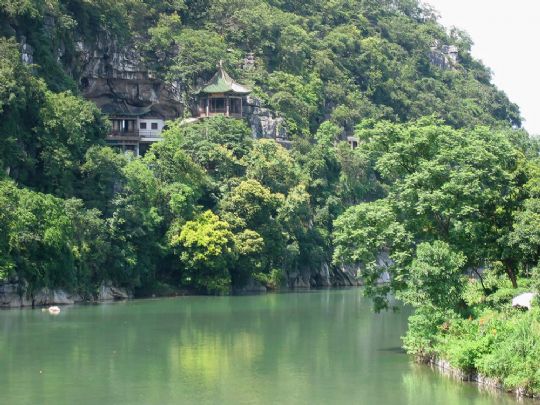
5. Seven Star Park

Seven Star Park got its name from seven peaks which should resemble the pattern of stars near the Big Dipper constellation, four peaks in the north called Putuo Hill and three in the south called the Lunar Hill. Seven Stars famous cave is located in Mount Putuo.

Seven Star Park, Guilin

It has been popular since the Sui (581-618) and (618-907) Tang Dynasty. The main sights contain Flower Bridge, Putuo Mountain, Seven Stars Cave, Camel Hill, Crescent Mountain, Guihai Stele Forest and Light of China Square.


Flower Bridge, built in the Song Dynasty (960-1279), is the oldest bridge in Guilin. Every spring and summer, he set out with flowers blooming and the river, then the name of the Flower Bridge.

An important feature of the Mount Crescent is 200 calligraphy carvings in the caves in it. This is said to be an important and talented work of calligraphy from the Tang (618-907 AD), Ming (1368-1644 AD) and Qing (1644-1911 AD) Dynasties. In the park, there is a view Karst, including caves and rocks. Dates back 1000 years ago, where it has become an attractive place for local people.


6. Tiger Hill Pagoda


Tiger Hill Pagoda or Pagoda Yunyan standing on top of the hill is part of the Temple Yunyan. As the oldest pagoda in Suzhou, it serves as a landmark city, was built during the late period of the Five Dynasties (907-959) and was completed in the second year of the Song Dynasty (959-961).

Tiger Hill Pagoda, Suzhou

It was built earlier and higher than the Leaning Tower of Pisa. Was originally built of wood, the structure of the complex, colorful and majestic with a unique style. The tower height is 48m, built with bricks laying eight cornered on the seventh floor. In more than a thousand years the tower has gradually slanted due to the forces of nature. It rests about 3.5 degrees north.

In 1957, efforts were made to stabilize and prevent further leaning tower. Concrete is also pumped into the ground to form a stronger foundation. During the process of strengthening, a stone coffin containing Buddhist scriptures were found.

Also the tower partially repaired in 1981 by local governments. Concrete piles have been driven into the ground around the pagoda to strengthen the foundation. As many Tang pagoda and the early Song period, it is a contemporary wood imitation stone pagoda. The "brackets" and "threshold" carved on the surface is not structural, but decorative.

Today pagoda 1000 year has been a symbol of Suzhou. And it is listed as one of the special historical sites under State protection. Temple was the highest point on the hill and has a magnificent view.


7. Yuyuan Garden

The park is believed to originate from the 16th century when Zhang Nanyang, architect, was commissioned by the family of a special Pan by Pan Ming court Yunduan build garden in honor of his father Pan En. The garden was reportedly first established in 1559 as a private garden, construction took nearly 20 years.

Yuyuan Garden in Shanghai

Yu Yuan Garden is an enclave of traditional Chinese architecture and classical gardens. One of the most popular tourist attractions in Shanghai, Yu Yuan Garden is worth a visit to the garden and tea house, especially if you do not get a chance to go to a park near the cities of Suzhou and Hangzhou. But lovely as it is, the right attraction for many who visit the Yu Yuan Garden is a huge bazaar that stretches from the central area and the entrance to the park, to the outskirts of the local environment. Here, great bargains on all sorts of things that can be found, from embroidered slippers, a "new" antique, lucky charms, fake paper money to burn for the ghost of your ancestors', umbrellas, and other knickknacks.